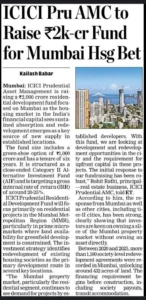
Seeing marquee institutional managers like ICICI Prudential AMC step in with a dedicated ₹2,000 Cr fund focused on MMR redevelopment reinforces a clear market reality. Do check the targeted IRR 🙂
Redevelopment is no longer just an alternative route; it has become the primary growth engine for urban real estate.
In core urban centers, traditional land acquisition typically eats up 40% to 50% of total project costs. It locks up massive upfront capital, exposes developers to title risks and severely compresses margins—especially in prime micro-markets where vacant land is virtually in non-existentence.
This is why institutional capital as well as developers is pivoting toward society redevelopment:
– Smarter Capital Allocation: Capital doesn’t get locked into expensive land equity. Instead, cash flow goes directly into approvals, transit rent payouts, and active construction.
– Enhanced FSI Potential: Policy incentives unlock higher saleable area in established micro-markets with proven pricing power and absorption.
– Superior Capital Efficiency: Lower initial equity outlays de-risk the balance sheet and deliver healthier project IRRs.
– Built-in Demand & Infrastructure: Existing residents get upgraded homes while the development leverages mature civic and transit networks.
On paper, it is a win for residents, developers, and municipal authorities alike.
Yet on the ground, many projects still struggle to move beyond the drawing board.
For developers, fund managers, and society members — what remains the single biggest bottleneck in executing redevelopment projects today? Is it consensus building, regulatory friction, or liquidity during the approval phase? Pls comment.
Image /News Source: The Economic Times | Kailash Babar | Aug 17, 2026
hashtagRealEstate hashtagUrbanRedevelopment hashtagRealestatefunds